

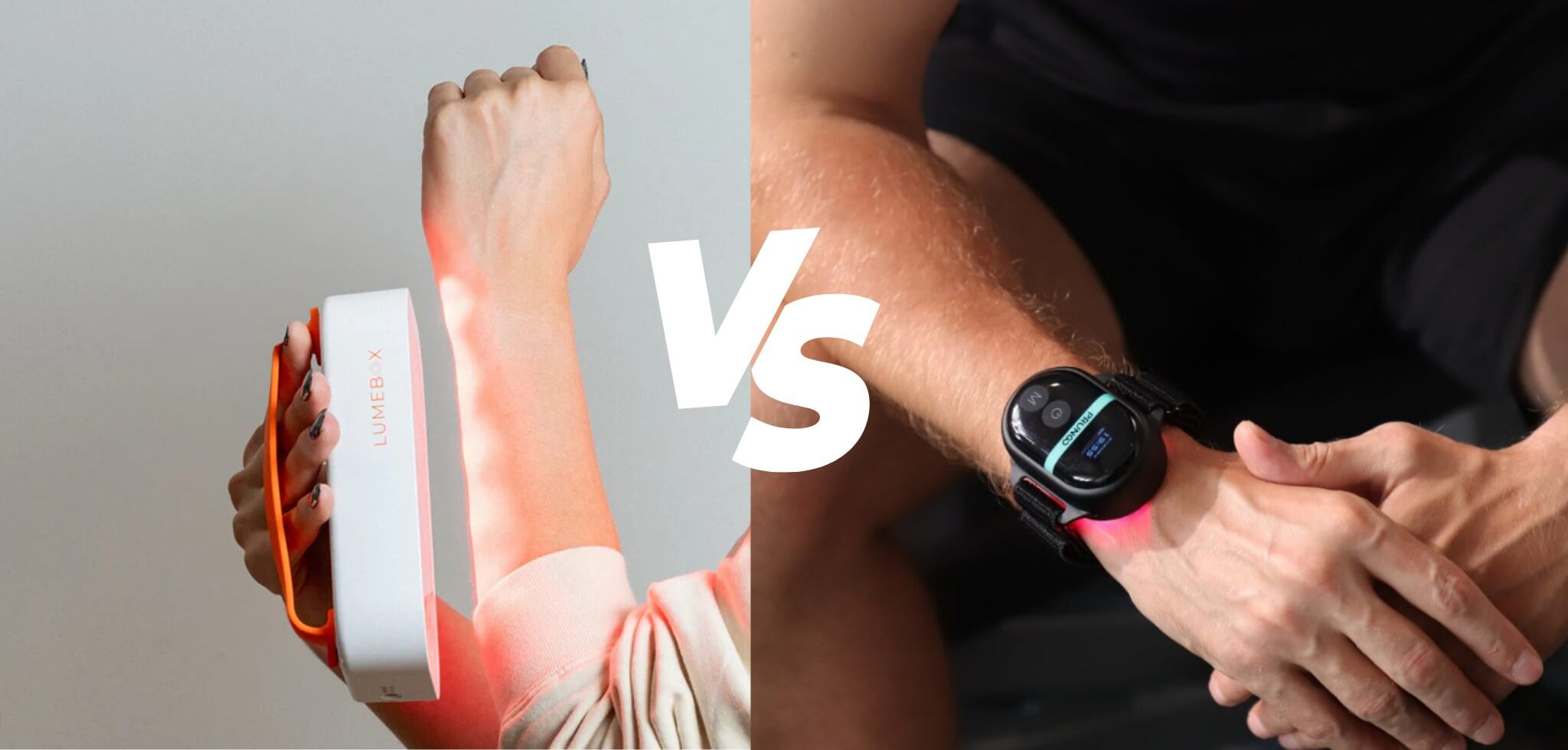
In today's Red Light Therapy (RLT) market, device form factors are undergoing a transformation. On one side, we have the handheld devices represented by LumeBox 2.0, prioritizing high power and versatility; on the other, we have the new generation of wearable modules represented by Prungo FluxGo, focusing on precision treatment and seamless lifestyle integration.
Many users find themselves torn when facing these two flagship products, which share a similar price point. This article will cut through the marketing jargon. Grounded in real specifications and the scientific principles of Photobiomodulation (PBM), we will provide an in-depth analysis of the distinct design philosophies behind these two devices and determine who they are best suited for.
1. Technical Specifications Comparison
Before diving deep, let's visually compare the hard specs of both devices.
| Spec Dimension |
LumeBox 2.0
|
Prungo FluxGo
|
| Form Factor | Handheld (Brick Design) | Modular Wearable (w/ Charging Case) |
| Light Source Tech | Dual-Chip LED | LED + Laser + Polarization |
| Wavelengths | 660nm (Red) + 850nm (NIR) | 650nm (Red) + 850nm (NIR Laser) |
| Irradiance | Ultra-High: 140 mW/cm² (NIR), 125 mW/cm² (Red) | Scientific/Optimal: 100 mW/cm² (NIR), 80 mW/cm² (Red) |
| Penetration Method | Power Stacking (Using high intensity to force penetration) | Physical Coherence (Laser + Polarization to reduce reflection) |
| Battery Life | Internal Battery (Official duration not specified) | ~75 mins per charge + 5000mAh Recharging Case |
| Best For | Large non-sensitive skin areas, superficial muscle relief | Deep joints, cartilage, sports injuries, chronic pain |
| MSRP | $629 | $599 |
| Street Price | Approx. $360 (With discount code) | $300 - $400 (Depending on promos) |


2. Core Philosophy: Do You Value "Handheld" or "Freedom"?
This is the most intuitive difference. Your lifestyle habits will directly dictate which device you will actually stick with.
LumeBox 2.0: The Handheld High-Power "Light Cannon"

LumeBox is one of the most popular handheld devices on the market, focusing on "High Irradiance" and "Large Coverage."
-
Form: It features a rectangular "brick" design with a solid feel.
-
Usage: You need to hold it against the affected area with one hand or purchase an extra stand to fix it in place.
-
Experience Advantage: Large Single Coverage Area. Compared to Prungo's smaller dots, LumeBox can cover half a face or an entire hand area at once.
Prungo FluxGo: Modularity & "True" Mobility
Prungo's design philosophy centers on "Targeted Recovery" and "Mobile Freedom."
-
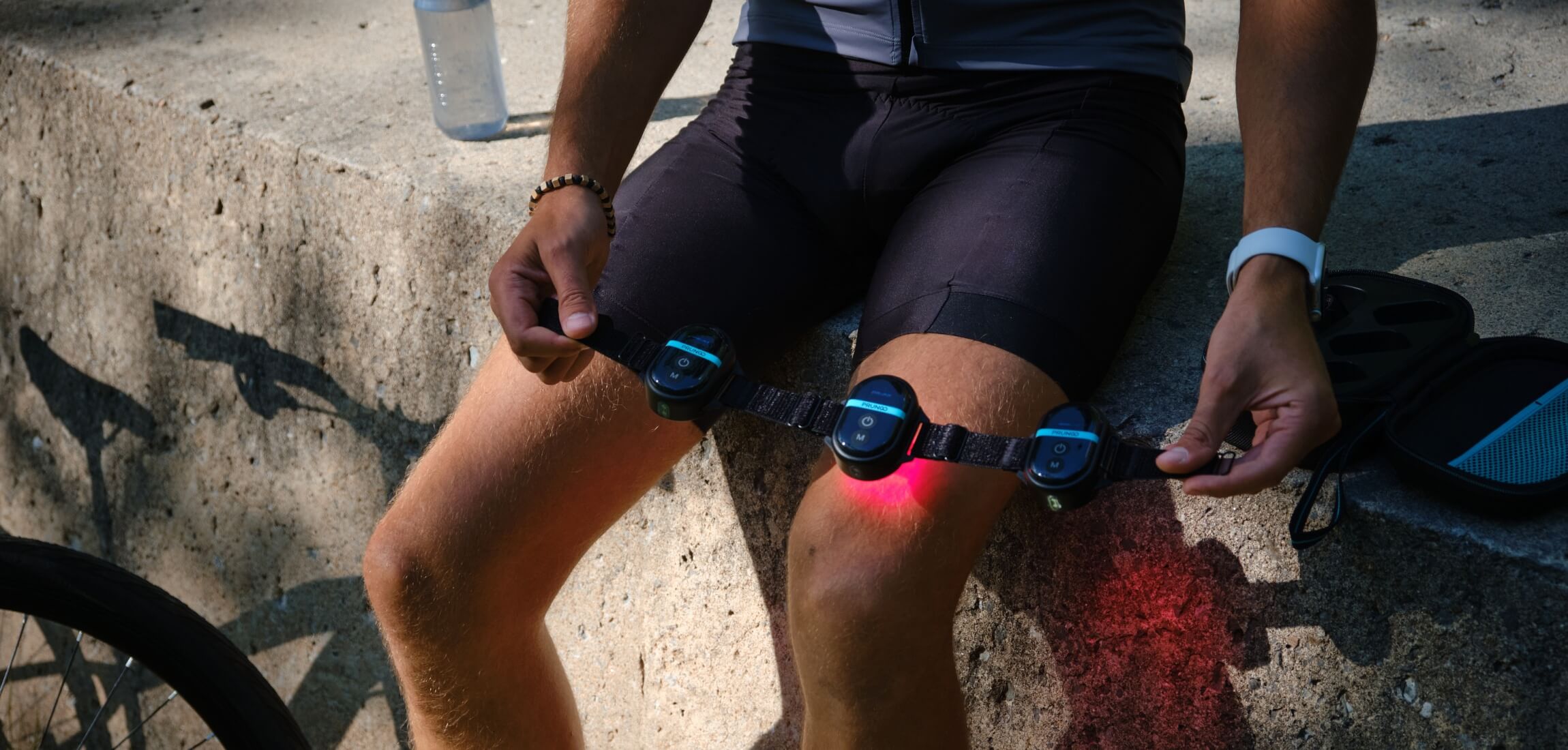
Form: It consists of independent circular light therapy modules. Using the accompanying straps, you can secure it to any joint (knees, shoulders, ankles).
-
Ultimate Portability: Prungo comes with a Charging Case similar to wireless earbuds. After use, simply drop the modules into the box to recharge, completely freeing you from cables and wall outlets.
-
Experience Advantage: Total Hands-Free Operation. You can strap it to your knee and do housework, work, or walk while treating. This "wear-and-forget" experience significantly lowers the barrier to consistent treatment.

3. Deep Dive: The Science of Irradiance & The "Bigger is Better" Myth
This is the most critical part of this review. LumeBox 2.0 markets its ultra-high irradiance (>125-140 mW/cm²) as a core selling point, but in Photobiomodulation (PBM) science, this is actually a potential hazard.
Scientific Fact: The Biphasic Dose Response (Arndt-Schulz Law)
Red light therapy is not about "the higher the energy, the better." It follows the "Biphasic Dose Response" principle: Insufficient energy is ineffective; moderate energy activates cells and accelerates repair (the optimal window); excessive energy causes inhibition and can even cause oxidative stress damage.

The LumeBox Hazard: The "Danger Zone" for Facial Care
LumeBox is often marketed for beauty, but its parameters may be too aggressive.
-
Facial Skin Threshold: Science suggests the safe and effective irradiance for facial care is typically between 20 - 50 mW/cm².
-
Potential Risk: LumeBox's intensity of 125-140 mW/cm² far exceeds the optimal absorption peak of facial skin. If used directly against the skin or at close range, long-term use could lead to thermal damage, hyperpigmentation, or collagen degradation. Users must carefully distance the device, but this makes precise dosage control difficult.
Prungo's Science: Precision Targeting for Deep Tissue
Prungo's design follows physiological logic more closely.
-
Deep Tissue/Joint Threshold: For knees and tendons, science suggests an effective irradiance of around 50 - 100 mW/cm².
-
Prungo's Numbers: 80 mW/cm² (Red) and 100 mW/cm² (NIR). This lands exactly in the "Goldilocks Zone" for deep tissue repair. It provides enough energy to penetrate without spilling over into the dangerous zone of inhibitory effects.
4. Technology Core: How to Achieve Deep Penetration?
Beyond raw power, the "Quality of Light" is key to efficacy.
LumeBox: The LED Power Strategy
LumeBox uses pure LED light sources (Incoherent Light). Photons scatter rapidly upon entering the skin. To solve the penetration issue, LumeBox's strategy is to increase power. While simple, this brute force approach can easily overheat the skin surface, while the proportion of effective photons reaching deep tissues isn't necessarily higher.
Prungo's Ace: Laser + Polarization

Prungo adopts a more expensive hybrid light source solution:
-
Laser Diodes: Its Near-Infrared light (850nm) is emitted by lasers. Lasers possess Coherence, meaning photons march in lockstep, penetrating human tissue with less resistance.
-
Polarization Technology: Prungo's light undergoes polarization treatment. The waveforms are aligned directionally, drastically reducing surface reflection (ordinary light is reflected by skin at a rate of 40%-60%), allowing more light energy to truly enter the joint cavity.
Conclusion: LumeBox uses "Brute Force" (High Power) to attempt penetration, while Prungo uses "Finesse" (Optical Physics) to directly reach the site of deep pain.
5. Price & Value Analysis
-
LumeBox 2.0: Street price approx. $360. Buying a high-power LED handheld device at this price is reasonable, but the premium is largely for brand marketing.
-
Prungo FluxGo: Street price approx. $300 - $400. At a similar price point, Prungo offers Laser Emitters, Polarized Lenses, and a complex Charging Case. From the perspective of hardware cost and technological content, Prungo clearly offers better value.

6. Final Verdict: Which Should You Buy?
Choose LumeBox 2.0 if:
-
You need to treat large areas of non-sensitive skin (e.g., back, thighs).
-
You don't mind handheld operation and have enough patience.
Choose Prungo FluxGo if:
-
You have chronic pain or joint issues (e.g., Runner's Knee, Arthritis): Laser and Polarization technology perform theoretically better for deep repair than standard LEDs.
-
You cannot stick to handheld devices: Prungo's "wear-and-forget" nature is key to consistent long-term treatment.
-
You value scientific safety: You want a device that strictly adheres to safe dosages, avoiding the risks of overdose.
In summary, LumeBox is a powerful, general-purpose handheld device, but one must be wary of the risks associated with its excessive irradiance. Prungo, on the other hand, is a "Deep Repair Specialist" designed based on cutting-edge photobiology, finding a more perfect balance between safety, efficacy, and portability.
"According to the Arndt-Schulz Law widely cited in PBM research (such as studies by Harvard's Dr. Michael Hamblin), light therapy follows a biphasic dose response [1]. For superficial tissue like facial skin, dermatological guidelines suggest an irradiance of 20-50 mW/cm² to avoid thermal inhibition [2]. Meanwhile, for deep tissue like knees, a range of 50-100 mW/cm² is considered the 'sweet spot' for effective penetration without surface overheating [3]."
[1] Huang Y-Y, et al. Biphasic Dose Response in Low Level Light Therapy. Dose-Response. 2009.
[2] Barolet D. Light-Emitting Diodes (LEDs) in Dermatology. Semin Cutan Med Surg. 2008.
[3] Hamblin MR. Mechanisms and applications of the anti-inflammatory effects of photobiomodulation. AIMS Biophys. 2017.
Share:
5 Red Flags to Watch For When Buying a Cheap RLT Device